
Why Fort Lupton Businesses Are Upgrading Their Water Purification
When business owners in Weld County start looking into commercial water purification in Fort Lupton, they often come to us with similar concerns: inconsistent water quality, scale buildup damaging expensive equipment, or compliance issues that need addressing before an inspection. At Water Works, we’ve spent years helping commercial clients throughout Colorado — from the Front Range to Idaho Springs and beyond — find water treatment solutions that actually fit their operations. We understand that commercial water needs are fundamentally different from residential ones, and a one-size-fits-all approach simply doesn’t work when your livelihood depends on consistent, clean water. Whether you’re running a restaurant, managing a manufacturing facility, or overseeing a multi-unit property, the water running through your pipes affects your bottom line in ways you might not even realize yet. In this post, we want to walk you through what commercial water purification involves, why it matters specifically for Fort Lupton businesses, and how we approach the process at Water Works so you can make informed decisions about your water treatment needs.
Understanding Fort Lupton’s Water Challenges
Fort Lupton draws its municipal water primarily from groundwater sources, and like many communities along the Front Range, the water here carries a unique mineral profile. Hardness is a consistent issue — calcium and magnesium levels tend to be elevated, which means scale accumulates quickly in pipes, water heaters, boilers, and any equipment that handles hot water. For businesses, that translates into higher energy costs, more frequent equipment maintenance, and shorter lifespans for appliances that should last years longer. Beyond hardness, we’ve also seen concerns around iron content, total dissolved solids, and seasonal fluctuations in water chemistry that can catch business owners off guard. The Colorado drinking water quality information published by CDPHE provides helpful context about what’s in municipal water supplies across the state, but it doesn’t address the specific challenges that commercial operations face. A restaurant in Fort Lupton has very different water requirements than a car wash or a medical facility. We’ve worked with businesses across the region — including clients in Idaho Springs where mineral content presents its own distinct challenges — and we always start by understanding the local water profile before recommending anything.
What Commercial Water Purification Actually Involves
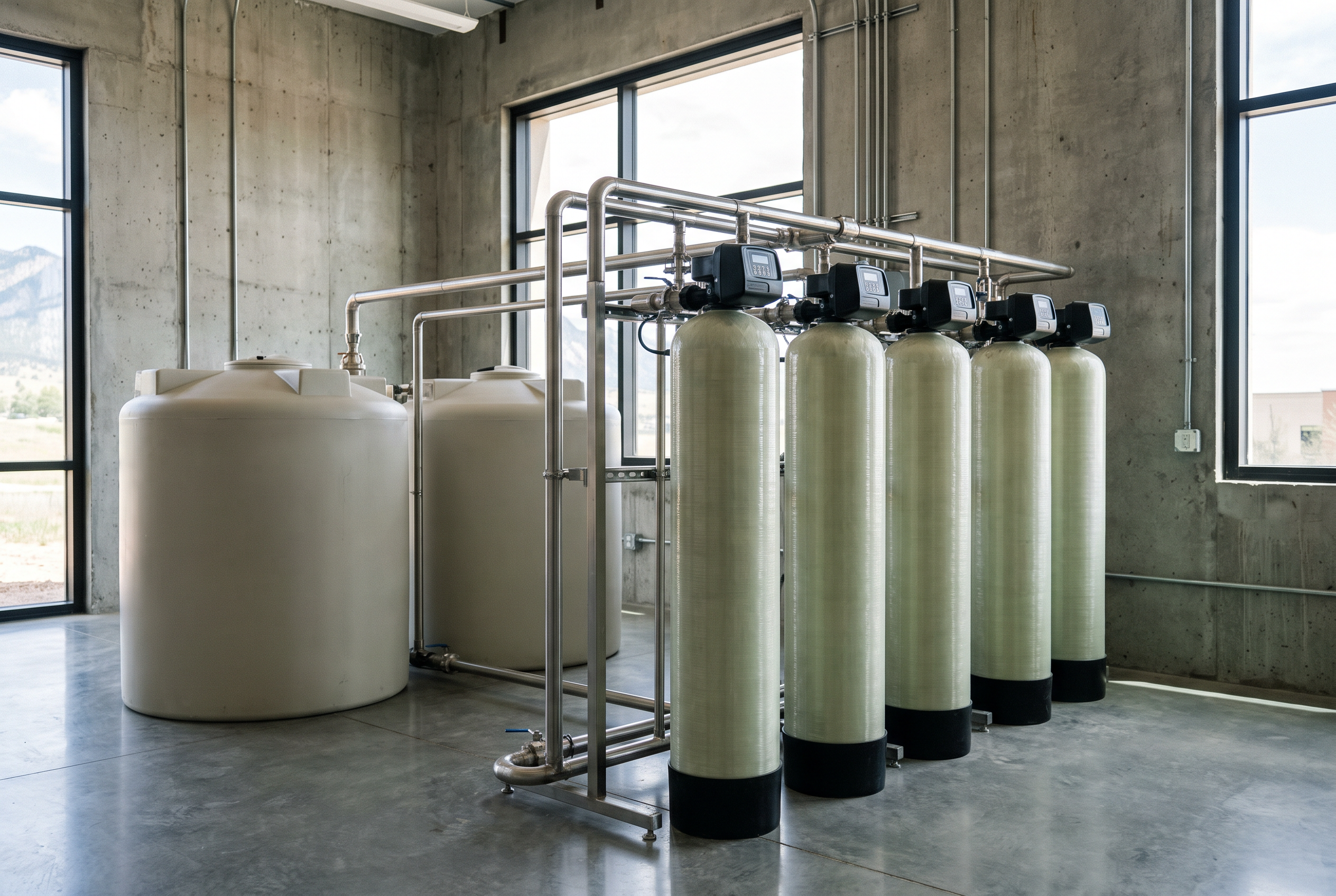
Commercial water purification is a broader term than many people realize. It encompasses several different treatment approaches, and the right combination depends entirely on what your business does and what your water contains. Water softening addresses hardness minerals through ion exchange, which is why many of our commercial clients benefit from our commercial water softener solutions — they protect equipment and improve cleaning efficiency. But softening alone doesn’t remove contaminants like chlorine, sediment, volatile organic compounds, or microbial concerns. That’s where additional filtration and purification technologies come in. Reverse osmosis systems can remove a wide spectrum of dissolved solids and contaminants, making them ideal for food service operations, laboratories, and manufacturing processes that require high-purity water. Carbon filtration handles chlorine and taste and odor issues. UV purification provides an additional layer of microbial protection without adding chemicals to the water. The EPA information on drinking water quality and treatment offers a solid overview of how these technologies work at a fundamental level. At Water Works, we don’t just install a single system and walk away — we assess your entire water usage profile, from intake to discharge, and build a treatment strategy that addresses each concern in the right sequence.
Industries That Benefit Most From Purified Water
While every business uses water, certain industries feel the impact of poor water quality more acutely than others. Food service operations are perhaps the most obvious — water is an ingredient in virtually everything served, and customers can taste the difference when water quality is inconsistent. Restaurants, coffee shops, and breweries in Fort Lupton and across Colorado rely on consistent water chemistry to produce the same product every time. Hospitality businesses, including hotels and multi-unit properties, face guest satisfaction issues when water smells, tastes, or feels wrong. Manufacturing operations often require specific water purity levels for their processes, and even slight variations can affect product quality. We’ve worked with clients ranging from small cafes in Idaho Springs to larger industrial operations along the Front Range, and the common thread is that untreated water costs money — sometimes in ways that aren’t immediately obvious. Energy bills climb as scale reduces heating efficiency. Equipment fails prematurely. Cleaning products don’t work as effectively, so you use more of them. The EPA WaterSense water efficiency resources highlight how water and energy costs are deeply connected, and proper treatment helps optimize both. Even businesses that don’t think of themselves as water-intensive — like offices with water coolers or retail spaces with restrooms — benefit from better water quality.
How Water Works Approaches Your Project
When you reach out to us about commercial water purification in Fort Lupton, we follow a structured process that takes the guesswork out of the equation. First, we conduct a comprehensive water test at your facility. This isn’t a basic strip test — we look at hardness, pH, total dissolved solids, iron, chlorine, and other relevant markers depending on your industry. Next, we assess your water usage patterns: peak demand times, daily volume, equipment connections, and any regulatory requirements you need to meet. We also consider growth — if you’re planning to expand, your system should accommodate that. From there, we design a treatment solution tailored to your specific situation. We’ve found that many businesses actually need less equipment than they initially thought, while others need more comprehensive treatment than they expected. Honesty matters to us, which is why we won’t oversell you on systems you don’t need. Our experience spans the entire state — from Fort Lupton to Idaho Springs and everywhere in between — and that geographic breadth gives us insight into regional water patterns that purely local companies might miss. We also handle installation, ongoing maintenance, and system monitoring so your water treatment stays effective year after year.
If you’re a business owner in Fort Lupton wondering whether your water could be costing you money or affecting your product quality, we’d welcome a conversation. At Water Works, we’ve built our reputation on practical, honest water treatment advice backed by real expertise. We serve commercial clients throughout Colorado and would be happy to evaluate your situation with no pressure. Give us a call at 303-248-3390 to schedule a water assessment or simply ask questions about what commercial water purification might look like for your operation. Clean, well-treated water is one of those behind-the-scenes factors that quietly affects nearly everything your business does — and getting it right pays dividends for years.