 Commercial Water Softeners
Service area · Parker · Douglas County
Water treatment in Parker
About 60,000 people call this Douglas County town home on the eastern slopes of the Palmer Divide, roughly 25 miles southeast of Denver along E-470 and Highway 83. Most addresses run on municipal water from the Parker Water and Sanitation District, a wholesale customer of Denver Water, while a meaningful share of larger-lot acreage east of town draws from private wells tapping the Dawson aquifer. Water treatment in Parker comes down to which of those two sources your property receives, because the working hardness, chlorine residual, and any plumbing pickup between the main and your faucet still reach the tap.

- Parker Water + WellsWholesale Denver Water surface supply in town; Dawson-aquifer wells on the acreage east
- Moderate + ChlorineModerate hardness, HAA5, trihalomethanes, lead in pre-1986 plumbing
Parker's two-source water picture
Parker Water's wholesale supply, and what reaches the tap after the distribution main
Parker sits on the eastern slopes of the Palmer Divide, about 25 miles southeast of Denver — a Douglas County town of roughly 60,000. Inside town, drinking water comes from the Parker Water and Sanitation District, which purchases treated surface supply from Denver Water and distributes it through Parker's own mains.
The treated surface water that reaches your tap still carries its working hardness and chlorine residual. Where that residual sits in the main overnight, haloacetic acids (HAA5) and trihalomethanes form — the EPA caps HAA5 at 0.060 mg/L and total trihalomethanes at 0.080 mg/L, and Parker Water lists both in its annual report. The older neighborhoods — the original Pinery phases, the first Stroh Ranch filings, Canterberry's older homes — add a plumbing layer: pre-1986 copper pipe with lead-soldered joints and brass fixtures that leach lead show up as trace metals the main never carried. East of town, the story shifts to Dawson-aquifer wells — hardness well above the town average, iron and manganese staining, arsenic, nitrates, and coliform after spring snowmelt. Every Parker job starts with an on-site analysis, because treatment has to fit the water you actually receive.
- Moderate hardness from treated Denver Water surface supply through Parker Water
- Haloacetic acids (HAA5) and trihalomethanes from the chlorine residual
- Bromodichloromethane and dibromochloromethane in the distribution-system residual
- Lead and copper pickup from pre-1986 solder and brass
- Iron, manganese, and arsenic on Dawson-aquifer wells east of town
- Nitrates and coliform on shallow wells in the ag-transition zones
Treatment for Parker homes
Water treatment in Parker, built around a wholesale supply and older plumbing
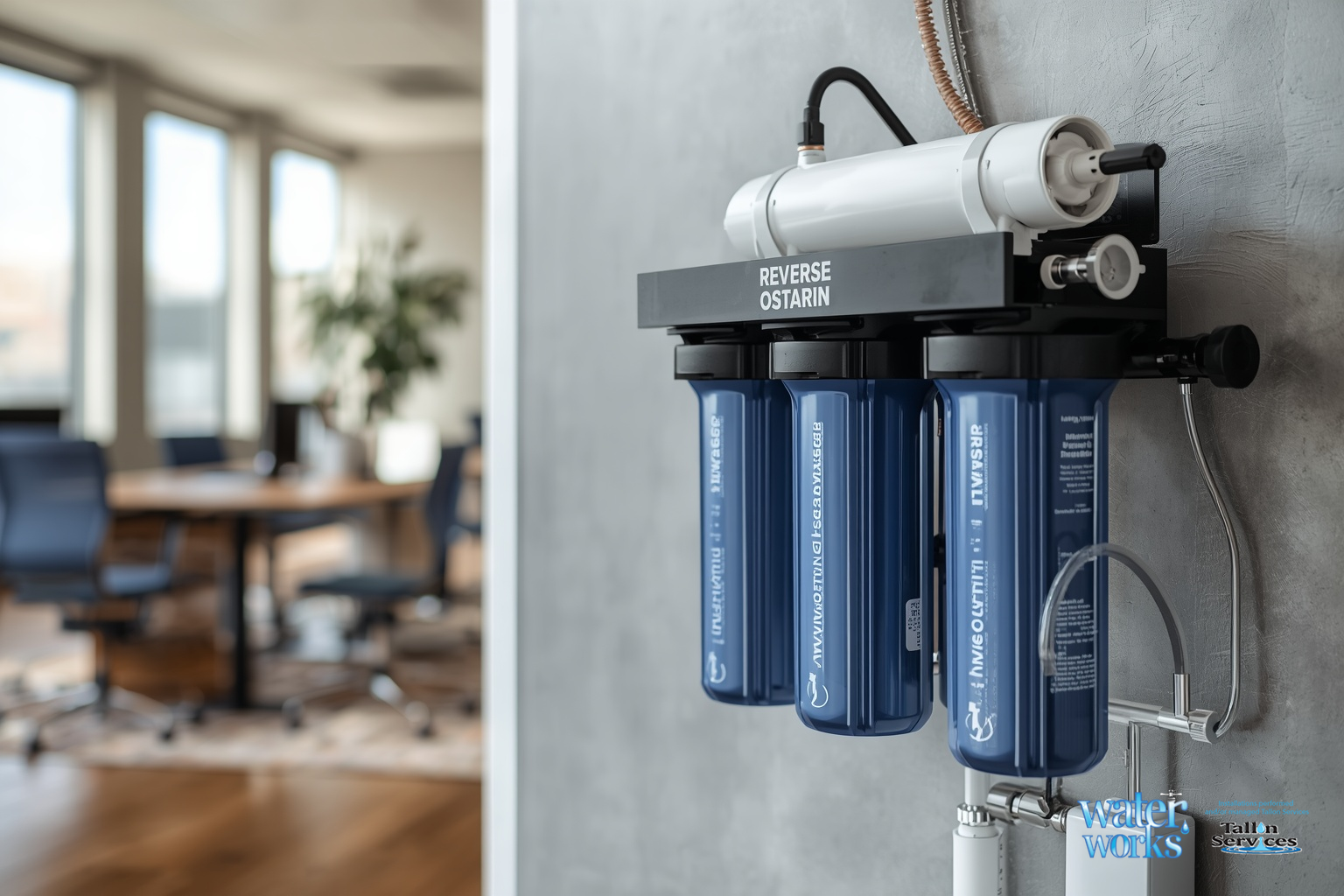
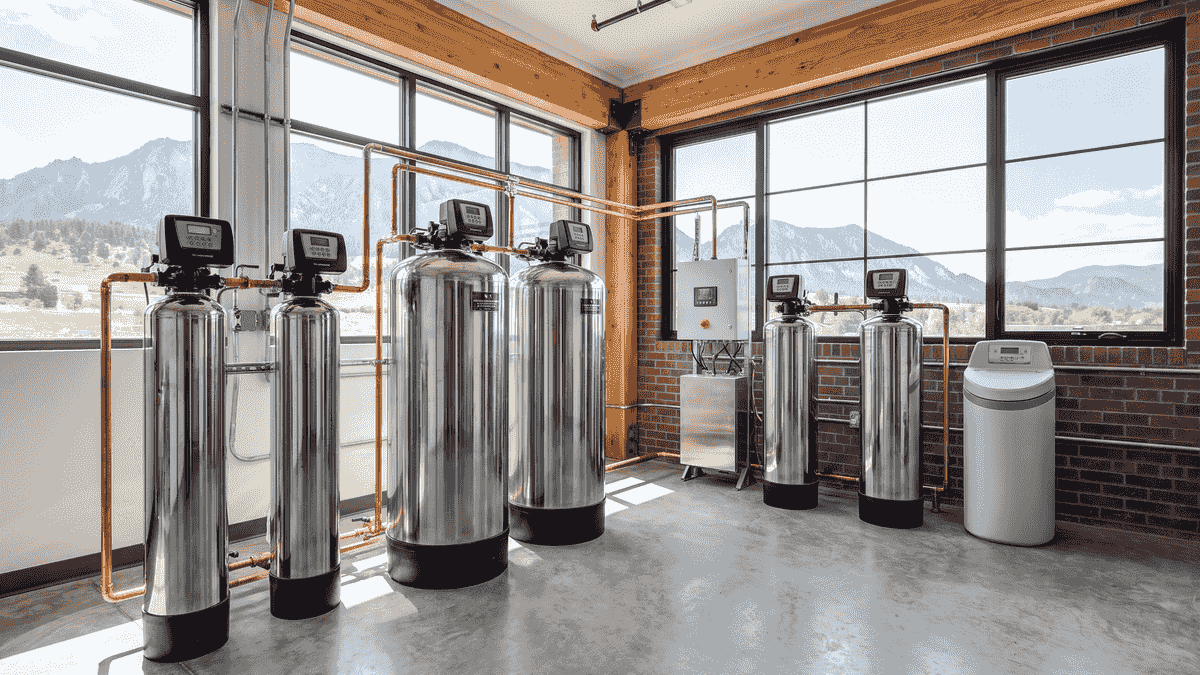
For most Parker homes on the district supply, the right water purification setup is a system matched to your water. A water softener at the point of entry tackles the working hardness and shields the water heater, dishwasher, and fixtures, while reverse osmosis in an under-sink water filter at the kitchen sink draws trace metals, disinfection byproducts, and residual radium to drinking-water levels. A carbon pre-stage ahead of the membrane knocks down chlorine taste and odor. Homes with lead-solder concerns — a meaningful share of The Pinery and the original Stroh Ranch phases, where pre-1986 plumbing is the norm — often add a whole house water filter and a lead-certified point-of-use filter at the kitchen tap as a stopgap until the old plumbing is replaced.
On the larger-lot acreage running private wells east of town, the treatment shifts. Wells carrying iron and manganese need oxidation filtration or a greensand stage before the softener; wells delivering arsenic need an anion-exchange stage. Shallow wells facing coliform risk get a UV disinfection stage, and a reverse osmosis system at the kitchen tap handles nitrates, VOCs, and what carbon misses. Where a homeowner wants scale control without sodium, salt-free water conditioners are an option — though on Parker's treated surface water they condition rather than soften.
- No-charge on-site water analysis
- Softeners matched to Parker Water hardness and Dawson-aquifer well water
- Iron and manganese treatment for the Dawson-aquifer wells east of town
- Reverse osmosis at the drinking-water tap — municipal or well
- Carbon stage for chlorine taste, odor, plus disinfection byproducts

South-metro dispatch
Routes to Parker along the E-470 and Highway 83 corridors
Where Parker sits on the map drives how service reaches it. The town lies on the Palmer Divide about 25 miles southeast of Denver, laced together by E-470 and Highway 83 — within easy reach of the Denver Metro office, so the run south past Centennial and Highlands Ranch into Parker is a normal daily stop. That matters more than you'd think, because most acreage homeowners east of town sit on private wells that few other companies bother testing.
From the Denver Metro office, routes fan out across the south-metro suburbs — Centennial and Highlands Ranch to the west along E-470, Castle Rock to the south along I-25 — and Parker's neighborhoods range from the older Pinery and Canterberry phases with pre-1986 plumbing to newer subdivisions like Anthology and Sagewood. Techs match each softener, pre-filter, and RO unit to the genuine reading at the tap, and each install goes on a yearly cycle — including water filtration maintenance and PFAS removal consultations. In April 2024 the EPA set enforceable PFOA and PFOS limits at 4.0 ppt, and Colorado has recorded contamination where industrial or firefighting-foam history points to it. Where subdivisions give way to Dawson-aquifer wells further east, our four regional offices dispatch statewide to fill the gap.
- Denver Metro office — south-metro corridor from Parker north through Highlands Ranch and into Denver
- Scheduled routes to Centennial, Highlands Ranch, Castle Rock, and Denver
- Well testing, softener, and RO installs on Dawson-aquifer acreage east of town
- Softeners sized for Parker Water's moderate hardness on every in-town install
- Statewide backup beyond the south-metro and Palmer Divide belt
Water treatment in Parker — questions we hear in Douglas County
Is Parker's drinking water safe at the tap?
Parker's drinking water comes through the Parker Water and Sanitation District, a wholesale customer of Denver Water — surface supply treated and disinfected upstream, then re-tested and distributed in Parker's mains. The plant-side standard is met. The faucet-side story is different: chlorine residual and its byproducts linger in the distribution main, and the lead and copper showing up at the tap originate in household plumbing — solder and brass fittings in pre-1986 homes, concentrated in the older phases of The Pinery, Stroh Ranch, and Canterberry. Testing at your own address settles what is actually in your glass.
What contaminants does Parker water most often carry?
Municipal customers inherit Denver Water's treated surface profile: chlorine residual plus the disinfection byproducts that form while that residual waits in the main — haloacetic acids (HAA5), total trihalomethanes, plus bromodichloromethane and dibromochloromethane — alongside hardness and trace metals from older plumbing. East of town toward the Plains, the larger-lot acreage relies on private wells tapping the Dawson aquifer, and the list shifts: iron and manganese staining, arsenic from the bedrock, nitrates where irrigated ag land sits upgradient, coliform after a big runoff event, and the occasional VOC near aging septic.
How frequently should Parker households test their water?
On the Parker Water and Sanitation District supply, an annual test covering lead and copper, hardness, chlorine residual, pH, and total dissolved solids is the baseline — with a closer look at the original Pinery, Stroh Ranch, and Canterberry streets, where plumbing predates the Lead and Copper Rule. Private-well properties east of town need an annual coliform, nitrate, arsenic, and iron panel. Re-test after a major storm or spring snowmelt pulse and after any well, pump, or plumbing work. Once a year is where it starts, not where it ends.
Is a water softener necessary for Parker homes?
For most, yes — even on the district supply. Parker Water and Sanitation District's treated Denver Water runs moderate hardness — roughly 75.4 mg/L (4.4 gpg), moderately hard and softer than most of the Denver Metro. At the tap, hardness climbs past that on the longer service runs and through the aging plumbing in The Pinery, Canterberry, and the first Stroh Ranch filings, and on the well properties east of town it runs well above. You'll see glassware spotting, scale on faucets and tile, stiff laundry, and appliances that quit early. A right-sized ion-exchange softener pulls out the calcium and magnesium behind it.
Can you reach homes beyond the Parker town boundary?
Yes. From the Denver Metro office — (303) 248-3390 — we cover Parker and the neighboring south-metro and Palmer Divide communities along the I-25, E-470, and Highway 83 corridors: Centennial, Highlands Ranch, Castle Rock, and Denver. Crews run scheduled routes across those corridors in every season. Dawson-aquifer well testing, softener and RO installs, and iron-and-arsenic filtration on the acreage east of town are everyday work. For anything beyond the south-metro belt, our four regional offices dispatch statewide.
Arrange your free Parker water analysis
See what your tap actually delivers — Parker Water supply in town, a Dawson-aquifer well on the acreage east, or an older Pinery, Stroh Ranch, or Canterberry home with pre-1986 plumbing. We come to your address, test on-site, walk you through the reading, and build treatment around your source and household. Call the Denver Metro office at (303) 248-3390 for prompt coverage across Parker and the surrounding I-25, E-470, and Highway 83 communities, with statewide backup for anything beyond.
Get a quote- Denver Metro(303) 248-3390
- Northern Colorado(970) 381-4493
- Colorado Springs Metro(719) 694-2650
- Pueblo & S Colorado(719) 836-8118
From the blog