
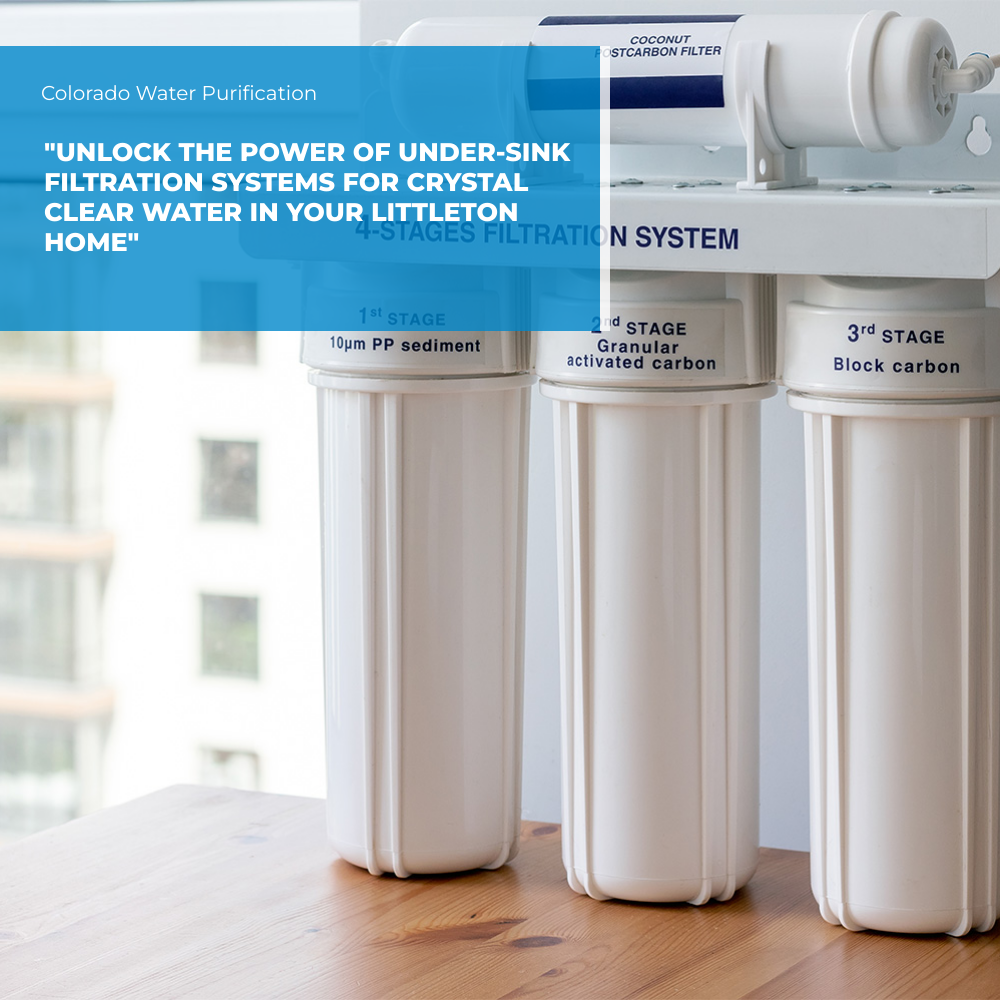
 Under Sink Water Filters
Service area · Littleton / South Denver Metro foothills
Water treatment in Littleton, tested at the tap
The South Platte carved Littleton's downtown, and the river still shapes the water — a south-Denver city of roughly 46,000 across Arapahoe, Douglas, and Jefferson counties, with a historic core in the valley climbing west into the foothills. Water treatment in Littleton starts with what your specific address receives. Most homes run on municipal supply from the Littleton Water and Sanitation District, purchasing treated Denver Water surface water; a small share of larger-lot homes on the western foothills edge and the southern acreage draw from private wells — harder, iron-bearing.

- Littleton W&SD + WellsDenver Water blend in the valley, private wells on the western foothills edge
- Moderately Hard 96.6 mg/LHardness from the Denver Water blend, harder on foothill-edge wells
- Free On-Site TestingWater analysis scheduled fast
Littleton's supply, from the Platte to your faucet
What the Littleton Water and Sanitation District delivers — and what picks up
Inside the South Platte valley, homes run on municipal water from the Littleton Water and Sanitation District, which purchases treated Denver Water surface supply. Out on the western foothills edge and the larger-lot southern acreage, the picture is private wells tapping foothills alluvial material. What reaches the faucet still carries the hardness and chlorine residual of any treated surface supply, and the chlorine sitting in the main overnight generates haloacetic acids (HAA5) and trihalomethanes — the EPA limits HAA5 at 0.060 mg/L and total trihalomethanes at 0.080 mg/L, and Littleton Water and Sanitation reports both. Radium, arsenic, and trichloroacetic acid are the contaminants homeowners ask about most. Inside the older in-fill neighborhoods — the historic Main Street corridor, Louthan Heights, and the 1950s–60s pockets through Bowmar, Columbine, and Southglenn — lead and copper show up at the tap from pre-1986 solder and brass fixtures. Out on the foothills edge, wells add iron, manganese, and arsenic to the baseline.
- Hardness from the Denver Water supply that the Littleton Water and Sanitation District distributes
- Disinfection byproducts (HAA5 and trihalomethanes) from the chlorine residual the district uses
- Lead and copper in pre-1986 homes — Louthan Heights, the Main Street corridor, and older in-fill pockets
- Naturally occurring radium, arsenic, and trichloroacetic acid reported in the Denver Water source
- Iron and manganese on private wells along the western foothills edge and the southern acreage
Treatment built for Platte-valley and foothills water
Water treatment in Littleton, designed around what your tap delivers
For most Littleton homes on the Littleton Water and Sanitation supply, the right system depends on what your water actually contains. A water softener at the point of entry handles the working hardness from the Denver Water blend and protects appliances and plumbing; a reverse osmosis unit under the kitchen sink pulls residual disinfection byproducts, trace metals, and any radium or arsenic down to drinking-water levels. Older homes in Louthan Heights and the Main Street corridor with lead-solder concerns often pair the treatment with an under-sink water filter or lead-certified filter at the kitchen tap until the plumbing is replaced.
For homes on private wells along the western foothills edge and the larger-lot southern acreage, the system is similar but different in the details. Wells running iron and manganese need an oxidation filter or greensand stage ahead of the softener; wells with arsenic need an anion-exchange or specialty media stage. Shallow wells with coliform risk add a UV stage, and RO at the kitchen tap covers nitrates and VOCs. We install and verify at every tap, then return annually — including water filtration maintenance after remodeling a pre-1980 home. For scale control without sodium, salt-free water conditioners protect fixtures without removing hardness. A whole house water filter at the point of entry rounds out the chlorine side.
- No-cost on-site water testing
- Softeners sized to the Denver Water blend hardness and to foothills well water
- Reverse osmosis for drinking-water taps
- Carbon filtration for chlorine and disinfection byproducts
- Iron and manganese filtration for foothill-edge wells in western alluvial material

Routes into the south-metro and the foothills belt
Getting to Littleton: Santa Fe Drive, the South Platte, and the foothills edge
Water treatment in Littleton runs out of our Denver Metro office — the city sits just south of Denver along the South Platte, close enough that a run to a Main Street home or a foothills well on the western edge is routine. Techs run south on Santa Fe Drive or I-25 and arrive as a scheduled stop — Englewood north, Centennial east, Highlands Ranch southeast. Most western foothills homeowners are on private wells nobody but us tests. Littleton's neighborhoods range from Main Street and Louthan Heights to newer foothills subdivisions, so techs size softeners, pre-filters, and RO units to the actual water reading. We keep every install on an annual testing cycle, and PFAS removal consultations are part of the work — the EPA set enforceable limits of 4.0 ppt for PFOA and PFOS in April 2024, and Colorado has documented contamination in areas with industrial or firefighting-foam history. Statewide dispatch out of our four regional offices covers the unincorporated Jefferson County foothill homes further out.
- Denver Metro office — South Platte valley and south-metro suburbs along I-25 and Santa Fe Drive
- Scheduled routes to Englewood, Centennial, Highlands Ranch, and Denver
- On-site well testing, softener installs, and RO work on western foothills well homes
- Annual testing programs across Littleton and the south-metro corridor
Littleton water — straight talk from the faucet
Is Littleton's tap water safe to drink?
For most of Littleton the tap water is municipal, tested, and treated — but that is not the same as being right for your house. The bulk of the city is served by the Littleton Water and Sanitation District, which purchases treated Denver Water surface supply and distributes it across the South Platte valley and the foothills. Denver Water publishes an annual Water Quality Report; Littleton Water and Sanitation adds its own Consumer Confidence Report. A small share of larger-lot homes on the western foothills edge and the southern acreage draw from private wells. The only way to know what is at your tap is a real on-site test.
What contaminants are most common in Littleton water?
On the Littleton Water and Sanitation side, the list starts with hardness from the Denver Water supply, plus chlorine residual and disinfection byproducts — haloacetic acids (HAA5), total trihalomethanes, bromodichloromethane, and chloroform. Denver Water's report also surfaces radium, arsenic, and trichloroacetic acid. Inside the older neighborhoods — the historic Main Street corridor, Louthan Heights with 1920s homes, and the 1950s–60s in-fill pockets — lead and copper show up at the tap from pre-1986 solder and brass fixtures. On private wells along the western foothills edge and the southern acreage, the profile shifts to iron and manganese as staining, arsenic from foothills alluvial material, nitrates and coliform after rain, and occasional VOCs near septic systems.
How often should I test my water in Littleton?
For homes on the Littleton Water and Sanitation system, test annually for hardness, chlorine residual, pH, total dissolved solids, and lead and copper — especially in older neighborhoods like the Main Street corridor, Louthan Heights, Bowmar, or Columbine. For private wells on the western foothills edge or the southern acreage, test annually for coliform, nitrates, arsenic, iron, and manganese. Test again after any major storm or spring runoff, after work on the well or plumbing, and after remodeling in a pre-1980 home. Once a year is the minimum — more often if your source or plumbing changes.
Do Littleton homes really need a water softener?
Most do. Littleton Water and Sanitation draws from the Denver Water blend, and the supply carries meaningful hardness — about 96.6 mg/L (5.7 gpg), moderately hard on the USGS scale. Inside many homes the working hardness climbs above that because of mineral pickup in older service lines and long distribution runs to the foothills-edge neighborhoods. You'll see it as spotting on glassware, scale on faucets and shower glass, and wear on water heaters and dishwashers. On private wells along the western foothills edge, the hardness often climbs higher because the foothills alluvial material adds more calcium and magnesium. A properly sized ion-exchange softener removes the minerals that drive the damage. Salt-free conditioners help scale cling less but do not remove the minerals, and on Littleton water the difference shows up fast.
Can you service my home outside of Littleton?
Yes. Our Denver Metro office at (303) 248-3390 covers Littleton and the south-metro communities along the South Platte and the Santa Fe Drive corridor — Englewood, Centennial, Highlands Ranch, Denver, and the unincorporated Jefferson County foothill homes just west of the city limits — with scheduled routes year-round. On-site testing, softener and RO installs, and iron-and-manganese filtration on western foothills wells are routine for that crew. Statewide dispatch out of our four regional offices covers the rest of Colorado.
Free Littleton water testing — schedule your visit
Find out what is in your water — municipal tap from the Littleton Water and Sanitation District in the South Platte valley, a private well on the western foothills edge, or an older home with pre-1986 plumbing along the Main Street corridor or in Louthan Heights. We test on-site and design treatment around your source. Schedule with our Denver Metro office at (303) 248-3390 for coverage across Littleton and the south-metro corridor — Englewood north, Centennial east, Highlands Ranch southeast — with statewide dispatch for anything further out.
Get a quote- Denver Metro(303) 248-3390
- Northern Colorado(970) 381-4493
- Colorado Springs Metro(719) 694-2650
- Pueblo & S Colorado(719) 836-8118
From the blog