 Fort Collins
Service area · Fort Collins / Cache la Poudre valley
Fort Collins water treatment built for the Cache la Poudre valley
Fort Collins sits where the Cache la Poudre River drops out of the foothills onto the high plains — a university city anchoring the northern Front Range, with the Cache la Poudre watershed as its drinking-water source and a band of older neighborhoods and rural edges. Most homes inside city limits draw from the Fort Collins Utilities municipal system, which pulls surface water from the Poudre, Joe Wright Reservoir, and Horsetooth Reservoir. Outside the service area, you're on a private well tapping the same Northern Colorado groundwater. The treatment that works here is the treatment designed around what your specific tap delivers.

- Cache la Poudre WatershedMunicipal surface water + private wells
- Hard + Iron + LeadHardness, fixture staining, older plumbing
- Free On-Site TestingFree water analysis, scheduled fast
The Cache la Poudre water story
Why Fort Collins water needs to be tested — not assumed
Fort Collins sits where the Poudre canyon opens out onto the high plains. Fort Collins Utilities pulls surface water from the Cache la Poudre watershed — the Poudre, Joe Wright Reservoir, and Horsetooth Reservoir — and treats it to meet federal standards. Outside the service area, almost every home draws from a private well tapping the same aquifer, and that's where the rules change.
Inside the municipal system, the contaminants at the tap are the ones that form between the plant and the kitchen sink. Chlorine reacts with natural organic matter and forms disinfection byproducts — trihalomethanes, haloacetic acids, chloroform, bromodichloromethane. Nitrate rides in from agricultural runoff during spring runoff and late-summer irrigation. In the older Fort Collins neighborhoods — the Laurel School Historic District, Sheely Drive, the manufactured-home communities along Harmony Village — lead and copper leach from original plumbing the utility can't monitor.
Outside the city limits on private wells, the profile shifts. Shallow wells take coliform and E. coli after spring runoff, nitrates from fertilizer and feedlot operations show up where irrigated cropland sits above the wellhead, arsenic is naturally present, and iron and manganese stain fixtures. Hardness runs higher than in town. We start every job with an on-site analysis.
- Disinfection byproducts — trihalomethanes and haloacetic acids in the municipal supply
- Nitrate from agricultural runoff in the watershed and upgradient wells
- Lead and copper leaching from older plumbing in established Fort Collins neighborhoods
- Hardness slightly higher than other Front Range communities
- Iron and manganese from fixtures, older service lines, and rural-edge wells
- Coliform and E. coli after spring runoff on shallow wells outside the city
How Water Works helps
Treatment designed around what your Fort Collins tap actually contains
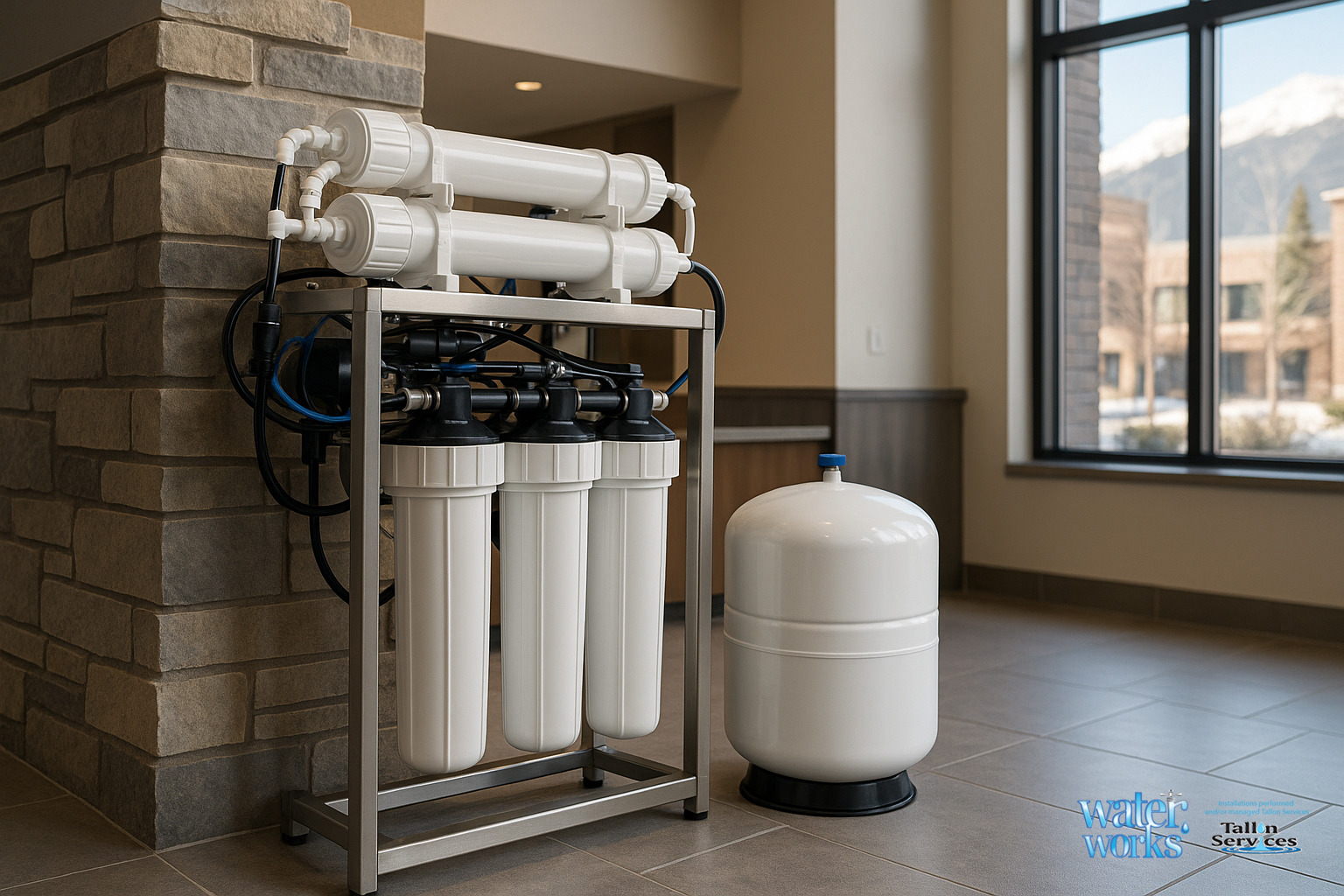
For most Fort Collins homes, the right answer is a layered system. A whole-house carbon filter strips chlorine and a share of the disinfection byproducts, and a reverse osmosis unit at the kitchen tap pulls out the trace contaminants you drink and cook with. Hardness is part of nearly every Fort Collins home we test, so a softener protects water heaters, dishwashers, washing machines, and ice makers from the scale that shortens their lifespans.
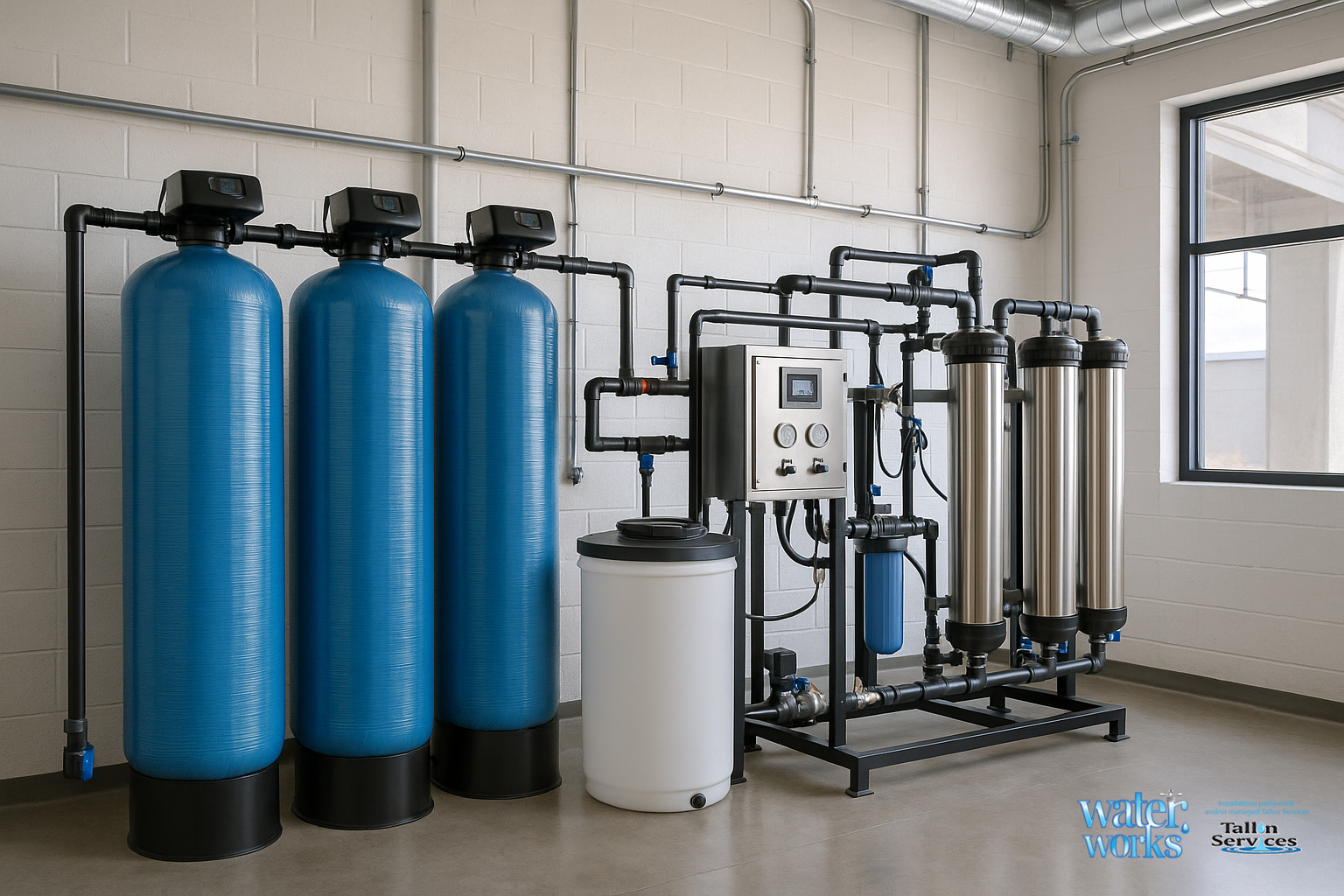
Homes in the older Fort Collins neighborhoods — original plumbing, pre-1970 service lines, manufactured-home communities with older brass fittings — pair the softener with a lead-and-copper reduction stage, because plumbing- related contamination is something the utility can't see. On the rural edges, the layered system expands: iron and manganese call for an oxidation filter or greensand stage, detectable nitrate for an anion-exchange stage, and coliform risk for UV disinfection. We design, install, and verify at every tap. We come back annually, and keep your system serviced season after season across Fort Collins and the Cache la Poudre valley.
- Free on-site water analysis
- Water softeners sized to Cache la Poudre valley hardness
- Reverse osmosis for drinking-water taps
- Activated carbon for chlorine and byproducts
- Iron and manganese filtration for rural-edge wells
- UV disinfection for bacteria on private wells
- Lead-and-copper plumbing retrofits for older homes
- Annual testing and ongoing service
Coverage across the Cache la Poudre valley
Service routes up and down the I-25 corridor
Fort Collins is the anchor stop on the Northern Colorado office's daily route. The office runs I-25 up and down the Front Range as a routine day, with Fort Collins, Windsor, Timnath, and Wellington as the northern stops and Loveland as the southern anchor. Coverage runs the I-25 corridor and east along the Poudre canyon into the rural properties that dot the valley. Water analysis, softener and RO installs, plumbing retrofits, and well work are routine for the crew.
What Fort Collins installs require is a little different from in-town work elsewhere. The older neighborhoods — Sheely Drive, the Laurel School Historic District, the manufactured- home communities — bring plumbing-era complications (original brass fittings, galvanized service lines, older solder) that newer subdivisions don't have, and the right system for a 1960s ranch is rarely right for a new build. Rural-edge well homes run higher service flow, longer plumbing runs, and a different contamination profile. Our techs size softeners, pre-filters, and RO units to the actual supply, not a generic spec.
Coverage beyond the immediate corridor runs through statewide dispatch out of our four regional offices. The Northern Colorado office is the primary dispatcher for this run. A service run up the I-25 corridor or out along the Poudre is a normal ask.
- Northern Colorado office — I-25 corridor from Fort Collins south through Loveland
- Scheduled routes to Windsor, Timnath, Wellington, and Laporte
- Rural-edge well work north and east of town along the Poudre canyon
- On-site water analysis, softener installs, and RO work on municipal and well homes
- Lead-and-copper plumbing retrofits for older Fort Collins neighborhoods
- Annual testing programs across the Cache la Poudre valley
Fort Collins water treatment FAQs
Is Fort Collins' tap water safe to drink?
It depends on which tap. Most of Fort Collins sits inside the Fort Collins Utilities municipal system, which pulls surface water from the Cache la Poudre watershed — the Poudre River, Joe Wright Reservoir, and Horsetooth Reservoir — and meets federal and state drinking-water standards. But 'meets the standard' and 'good at your kitchen sink' are not the same thing. Disinfection byproducts form where chlorine meets organic matter in the distribution system, nitrates ride in seasonally from agricultural runoff, and lead and copper leach from the original brass and galvanized plumbing in older Fort Collins homes — the Sheely Drive area built in the 1950s, the Laurel School Historic District built between 1870 and 1930, and the manufactured-home neighborhoods along Harmony Village. Outside the city service area you're on a private well, where the rules are completely different.
What contaminants are most common in Fort Collins tap water and well water?
Inside the Fort Collins Utilities service area, the most common contaminants are disinfection byproducts — total trihalomethanes (TTHMs) like chloroform and bromodichloromethane, and haloacetic acids (HAA5) — plus nitrate, copper, fluoride, and lead leaching from older plumbing. The water itself is slightly harder than in many Front Range communities. Outside on private wells, the list changes: coliform and E. coli after heavy spring runoff, nitrates from fertilizer and feedlot operations upgradient in the watershed, arsenic from the underlying alluvial material, iron and manganese that stain fixtures, and VOCs near older septic systems or commercial sites. A real on-site analysis is the only way to know which your tap or well actually has.
How often should I test my water in Fort Collins?
At least once a year for any home — municipal or private well — and more often if you've had a positive result, if your home sits in an older neighborhood with original plumbing, if your well is shallow or sits close to irrigated cropland, or if your water changes in taste, smell, or color. Disinfection byproducts and nitrate are seasonal and event-driven: spring runoff and late-summer irrigation are the classic windows for a positive result. After any work on the well, the pump, or the plumbing, test before you drink it. Older Fort Collins homes with original service lines should test for lead and copper at the tap every few years even when the municipal supply is fine.
Do Fort Collins homes really need a water softener?
Yes — Fort Collins water tends to be slightly harder than other Front Range communities, and hardness is part of nearly every home we test in town. You'll see it as spotting on glassware, scale on faucets and shower glass, and shortened lifespans for water heaters, dishwashers, washing machines, and ice makers. On the rural edges where wells draw harder groundwater from the same aquifer, the need is sharper still. A softener isn't luxury — it's the difference between appliances that last 15 years and ones that last 6. Salt-free conditioners help with scale but don't actually remove the hardness minerals the way a proper ion-exchange softener does.
Can you service my home outside of Fort Collins?
Yes. Our Northern Colorado office covers Fort Collins and the surrounding Cache la Poudre valley communities — Windsor, Timnath, Wellington, Laporte, and the rest of the I-25 corridor north through Loveland — and our service techs run scheduled routes up and down the Front Range every week. On-site water analysis, softener and reverse osmosis installs, plumbing retrofits, and well work on the rural edges are routine jobs for that crew. For properties further out along the Poudre canyon and the wider Northern Colorado plains, statewide dispatch out of our four regional offices covers the gap, and a service run into that country is a normal ask.
Get a free water analysis in Fort Collins
Find out what's actually in your water — Cache la Poudre valley municipal tap, older Fort Collins home with original plumbing, or rural-edge well north and east of town. We'll test on-site, walk you through the results, and design a treatment system around your source, your household, and your preferences. Reach the Northern Colorado office at (970) 381-4493, or use statewide dispatch through any of our four regional offices.
Get a quote- Denver Metro(303) 248-3390
- Northern Colorado(970) 381-4493
- Colorado Springs Metro(719) 694-2650
- Pueblo & S Colorado(719) 836-8118
From the blog