 Commerce City
Service area · Commerce City / Inner-ring north / I-70 corridor
Water treatment in Commerce City for north-metro homes
Water treatment in Commerce City begins with the blend. Commerce City is a north-Denver suburb of roughly 65,000 in Adams County — an industrial and residential city along the South Platte and Sand Creek corridors between Denver and Brighton. The supply comes from the South Adams County Water and Sanitation District (SACWSD), which blends Denver Water surface supply with its own shallow alluvial aquifer wells — a blend harder than the Denver Water core. Older industrial parcels and small-acreage properties draw from private wells on the same alluvial material.
- SACWSD + WellsDenver Water blended with alluvial groundwater
- Hard + IndustrialHarder than the Denver Water core, plus older industrial sites
The South Platte corridor supply story
What SACWSD's blend carries to your faucet — and what the old pipes add
Water treatment in Commerce City means understanding what SACWSD's blend actually carries. The District blends Denver Water surface supply with its own shallow alluvial wells along the South Platte and Sand Creek — harder than the Denver Water core because the alluvial side carries calcium and magnesium. The District's Consumer Confidence Report is open about the hardness.
What reaches the tap carries the working hardness of the alluvial blend, and in older homes in Derby Downtown, Irondale, and Adams City the story picks up a plumbing layer — lead solder in pre-1986 copper pipe and brass fixtures show up as trace metals the distribution never saw. The chlorine residual sitting in the main overnight generates disinfection byproducts the main — the EPA limits HAA5 at 0.060 mg/L and total trihalomethanes at 0.080 mg/L, and SACWSD reports both in its annual report. Outside SACWSD, private wells on the same alluvium run harder — iron, manganese, arsenic, nitrates after heavy rain. Every Commerce City job starts with a real on-site analysis.
- Hardness from the alluvial side of the SACWSD blend — higher than Denver Water core
- Disinfection byproducts (HAA5, trihalomethanes) from the chlorine residual
- Iron and manganese from the alluvial material as staining
- Lead and copper pickup in pre-1986 homes — Derby Downtown, Irondale, Adams City
- Nitrates and coliform on private wells outside SACWSD after heavy rain
Treatment built around Commerce City's water
Softeners, RO, and whole-home filtration designed for Commerce City water
Commerce City's SACWSD grid threads through industrial corridors and older residential blocks alike, so the water at your tap hinges on which stretch of main feeds your block. Homes near the plant get one profile; homes toward the refinery frontage and Sand Creek industrial corridor get another — more time for byproducts to form overnight, and a stronger case for reverse osmosis at the kitchen tap. A water softener sized to a city average doesn't always match what's coming out of your faucet, so every system we put in is tuned to the actual reading at your spigot — never a guess from a spec sheet.
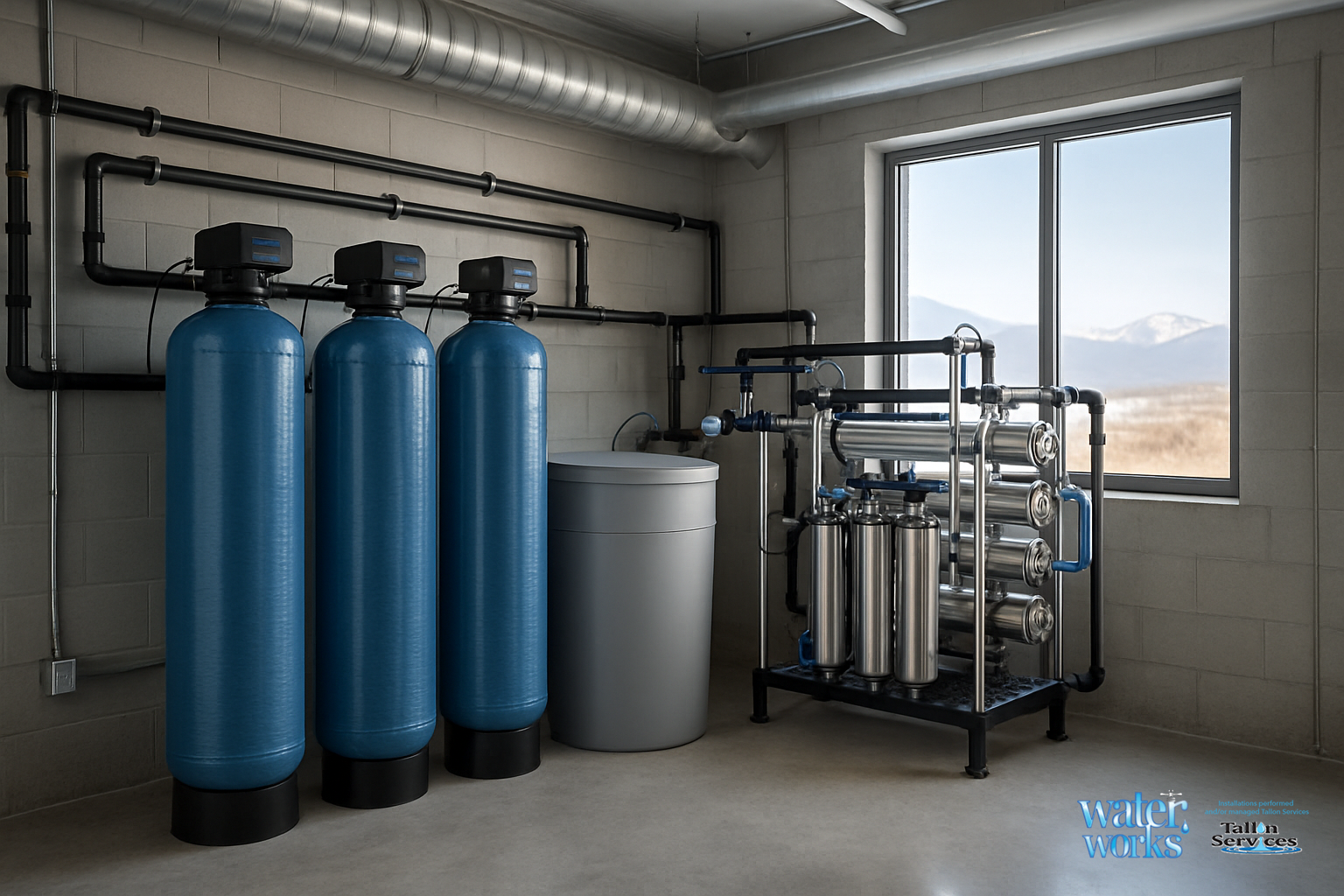
In Derby Downtown, Irondale, and Adams City, the pre-1986 housing stock adds a metals layer the utility never caused — a whole house water filter at entry catches particulate and chlorine, and a point-of-use lead-certified filter at the kitchen tap handles the metals old solder contributes. The Sand Creek and I-70 industrial corridor is where PFAS and VOCs enter the conversation: refinery and heavy-industry parcels sit upgradient of some residential blocks, and specialty-media stages for PFAS removal and VOC reduction are added when the test calls for it. Where wells take over, the treatment shifts: a larger softener, a greensand stage for iron and manganese, UV for coliform on shallow completions, and salt-free water conditioners for scale control without sodium exchange.
- Complimentary on-site water test
- Softeners sized to SACWSD hardness and industrial-corridor wells
- Carbon filtration for chlorine taste, odor, and byproducts
- Specialty media for VOCs and PFAS near older industrial sites
- Reverse osmosis for drinking-water taps (city and well)

Coverage across the inner-ring north and I-76 corridor
Dispatching techs to Commerce City along I-70, I-76, and US 85
Commerce City is a quick hop north from the Denver Metro office up I-25 or east on I-70 — close enough that a SACWSD-supplied home or an industrial-corridor well is an ordinary stop, not an expedition. Coverage runs the I-70 and Sand Creek corridors east and the I-76 and US 85 corridors north — Denver to the southwest, Aurora to the southeast, Thornton and Northglenn to the west, Brighton to the northeast. On-site well testing, softener and RO installs, and specialty-media work for industrial-corridor homes are routine.
Each install goes on a yearly check-back schedule — covering water filtration maintenance and PFAS removal follow-ups. The EPA's April 2024 rule set a 4.0 ppt enforceable ceiling on PFOA and PFOS, and Colorado has tracked contamination near industrial sites and firefighting-foam areas — a real concern given the refinery and heavy-industry footprint along Commerce City's Sand Creek frontage.
- Denver Metro office — I-70 corridor and the inner-ring north reach into Adams County
- Scheduled routes to Denver, Aurora, Thornton, Northglenn, and Brighton
- On-site well testing, softener installs, and RO work on industrial and residential parcels
- Statewide dispatch for anything further out along the I-76 corridor or the Eastern Plains
Water treatment in Commerce City — questions homeowners ask
Is Commerce City's tap water safe to drink?
Commerce City's tap water comes from SACWSD, which blends Denver Water surface supply with its own alluvial groundwater. The District's Consumer Confidence Report is open that Commerce City runs hard water because the alluvial side of the blend carries calcium and magnesium. 'Treated at the plant' and 'right at your faucet' are not the same thing: the working hardness is higher than the Denver Water core, chlorine residual is on by design, and older homes in Derby Downtown, Irondale, and Adams City often have pre-1986 plumbing that adds trace metals between main and faucet. A real on-site test is the only way to know.
What contaminants are most common in Commerce City water?
On the SACWSD side, the list starts with hardness from the alluvial aquifer, plus iron and manganese as staining, chlorine residual and the disinfection byproducts from the chlorine sitting in the main — haloacetic acids and trihalomethanes headline the District's annual report. Lead and copper show up in pre-1986 homes as plumbing-side pickup, and the older industrial corridor along Sand Creek and I-70 is why the lab list also includes occasional VOCs and PFAS near older industrial parcels. On private wells outside SACWSD: hardness and iron as baseline, manganese staining, arsenic from the deeper alluvial, nitrates from fertilizer and feedlot runoff, and coliform after heavy rain.
How often should I test my water in Commerce City?
On the SACWSD supply, test yearly for hardness, iron, manganese, pH, TDS, chlorine residual, disinfection byproducts (HAA5, TTHMs), and lead and copper if your home was built before 1986. On a private well outside SACWSD, test annually for coliform, nitrates, and arsenic. Retest after heavy rain or flooding on the South Platte, after a snowmelt pulse, after work on the well or plumbing, and after nearby construction along the industrial corridor. Once a year is the minimum — more often if conditions change.
Do Commerce City homes really need a water softener?
Most do. The SACWSD blend is harder than the Denver Water core, and what reaches the tap is already at moderately hard levels — about 95.1 mg/L (5.6 gpg) on the USGS scale. Inside many homes the working hardness climbs higher because of mineral pickup in older copper service lines and the long runs to the industrial-corridor neighborhoods. You'll see it as scale on fixtures and shower glass, spotting on glassware, and wear on water heaters, dishwashers, and ice makers. A properly sized ion-exchange softener removes the calcium and magnesium; salt-free conditioners help with scale but do not pull hardness minerals out.
Can you service my home outside of Commerce City?
Yes. Our Denver Metro office at (303) 248-3390 dispatches Commerce City and the inner-ring north communities along the I-70, I-76, and US 85 corridors — Denver to the southwest, Aurora to the southeast, Thornton and Northglenn to the west, Brighton to the northeast — with techs running scheduled routes year-round. On-site well testing, softener and RO installs, and specialty-media work older industrial-corridor homes need are routine. Statewide dispatch out of four regional offices covers anything further out along the I-76 corridor or the Eastern Plains.
Is reverse osmosis in Commerce City worth it for drinking water?
For most Commerce City homes, yes. SACWSD meets federal and state standards at the plant, but chlorine residual, disinfection byproducts, trace metals from older plumbing, and industrial-era contaminants near older parcels are all still present at the tap to some degree. A reverse osmosis system at the one tap your family drinks from pulls those down to drinking-water levels. An under-sink RO unit with a carbon stage ahead of the membrane is the standard setup for SACWSD supply homes. For industrial-corridor wells, RO also handles nitrates and any VOCs the well delivers.
Schedule your free Commerce City water test
Find out what your Commerce City tap actually delivers — SACWSD city supply, an industrial-corridor well near Sand Creek, or a pre-1986 home in Derby Downtown, Irondale, or Adams City with original plumbing. We test on-site, walk you through the results, and design a treatment system around your source. Schedule with our Denver Metro office at (303) 248-3390 for coverage across Commerce City and the inner-ring north along the I-70, I-76, and US 85 corridors.
Get a quote- Denver Metro(303) 248-3390
- Northern Colorado(970) 381-4493
- Colorado Springs Metro(719) 694-2650
- Pueblo & S Colorado(719) 836-8118
From the blog