 Pfas Removal
Service area · Pikes Peak region
Colorado Springs water treatment built for the Pikes Peak region
For more than 40 years, Water Works has treated water across Colorado, and Colorado Springs — the state's second-largest city — is one of the markets we know best. Water here comes from Pikes Peak snowmelt delivered by Colorado Springs Utilities, supplemented by private wells on the periphery in Black Forest, Falcon, Peyton, Calhan, Security-Widefield, Fountain, and Monument. The treatment that actually works in this region is the treatment designed around what your specific source delivers.
- Pikes Peak WatershedSnowmelt-fed surface water + private wells
- Municipal + WellsPFAS, lead, and aging plumbing to manage
- Free On-Site TestingFree water analysis, scheduled fast
The Pikes Peak water story
Why Colorado Springs water needs to be tested — not assumed
Colorado Springs Utilities runs a serious operation. The Pikes Peak watershed is one of the cleanest surface-water sources in the country, and the utility treats it well — running tens of thousands of source and distribution samples a year and publishing the results in the annual water quality report. That work is real, and it shows up as a generally low-risk municipal supply.
But the water that comes out of your tap isn't the water that left the plant. Disinfection byproducts form in the distribution system as the finished water ages in miles of main, and lead and copper can leach from older brass and galvanized service lines and household plumbing between the meter and the tap. PFAS, chromium 6, and trace radium are regularly detected in compliance reports at low levels, and the utility isn't responsible for — and doesn't test for — what happens inside the home.
Out in the periphery, private wells draw from a different world entirely: harder water, iron and manganese, arsenic where the formation is right, and nitrates where the surrounding land is agricultural. A treatment system designed for someone else's water almost never fits yours. We start every Colorado Springs job with a real on-site analysis and design from the results.
- PFAS and other persistent compounds at the meter
- Trihalomethanes (chloroform, bromodichloromethane, total THMs)
- Haloacetic acids and dichloroacetic acid
- Lead and copper from older household plumbing
- Arsenic in private wells and some distribution zones
- Hardness, iron, and manganese on the periphery
- Nitrates from agricultural runoff on outlying wells
- Chromium 6 and trace radium in CCR reports
How Water Works helps
Treatment designed around what your water actually contains
For most Colorado Springs homes, the right answer is a layered system: a softener at the point of entry to handle hardness and protect appliances, plus a reverse osmosis unit or under-sink filter for the kitchen tap where you actually drink and cook. Wells with iron, manganese, sulfur, or arsenic usually need a dedicated pre-filter or media tank ahead of the softener, and municipal customers with chlorine-taste or disinfection-byproduct concerns often pair the softener with a small carbon polishing filter to take the bite out of the tap water.
We design the system, install it, and verify the treated water meets the mark at every tap it's used. Then we come back: well water should be tested at least once a year, and we keep your system serviced and your water verified season after season — including after wildfires, after floods, and after the periodic changes in source water that come with a fast-growing region.
- Free on-site water analysis
- Water softeners sized to your hardness
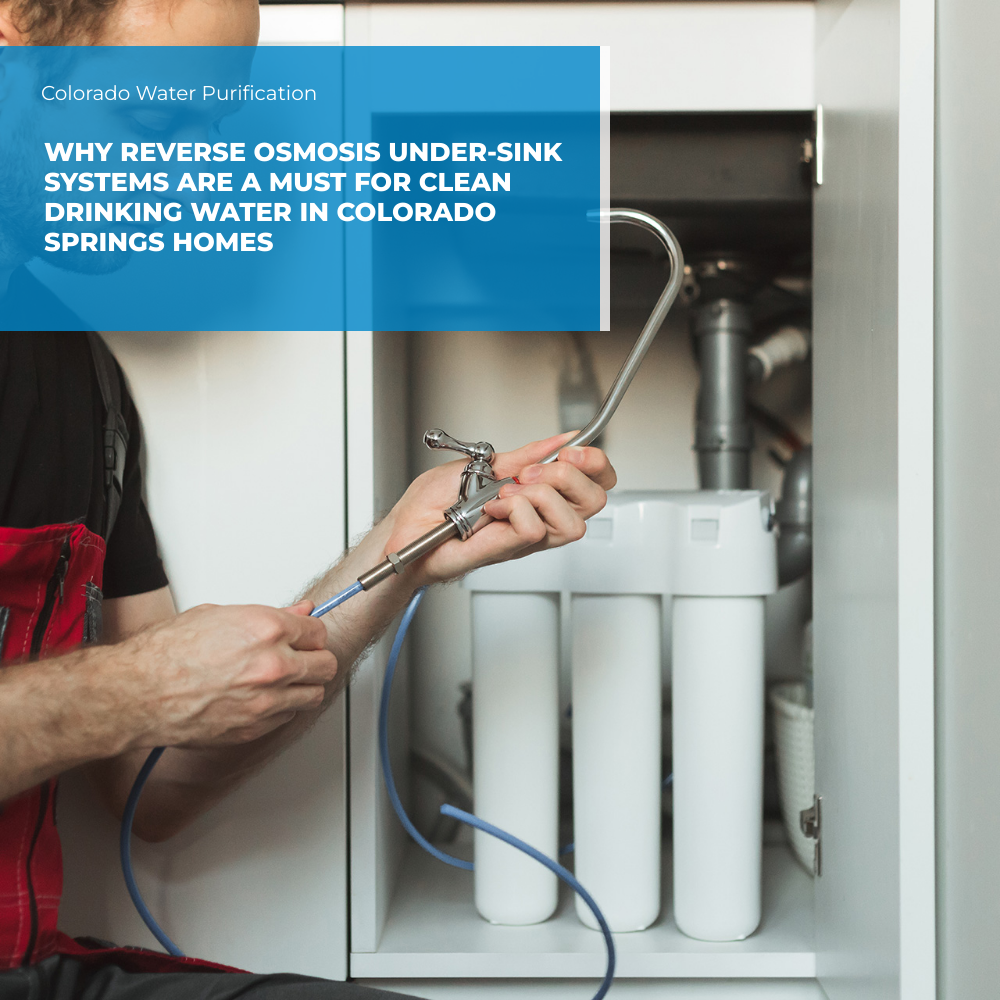
- Reverse osmosis for drinking water
- Iron, manganese, and arsenic filtration
- UV disinfection for bacteria
- Annual testing and ongoing service
Colorado Springs water treatment FAQs
Is Colorado Springs' tap water safe to drink?
Colorado Springs Utilities treats Rocky Mountain snowmelt from the Pikes Peak watershed and runs an aggressive sampling program — roughly 12,000 source and distribution tests a year. That real work shows up in the annual water quality report, which still commonly lists PFAS, bromodichloromethane, chloroform, haloacetic acids, total trihalomethanes, dichloroacetic acid, chromium 6, and trace radium at the meter. And that's before anything that happens in the service line and plumbing between the meter and your kitchen tap, where lead and copper can still leach from older brass and galvanized components. Safe and good are not the same thing — only a real on-site analysis tells you what's actually coming out of your tap.
What contaminants are most common in Colorado Springs well water?
Out in Black Forest, Falcon, Peyton, Calhan, Security-Widefield, and the eastern Plains fringes, wells routinely test high for hardness, iron, and manganese, with arsenic showing up often enough to matter where the formation is right. Nitrates from agricultural runoff are recurring, coliform bacteria turn up after heavy rain or flood events, and we periodically see VOCs in shallow wells near older septic systems or commercial sites. The water table varies block by block across the Pikes Peak region — a genuine analysis tells you which of these yours has, and guessing isn't a strategy.
How often should I test my water in Colorado Springs?
At least once a year for a private well — more often if you've ever had a positive result, if your area has known issues, or if your water changes in taste, smell, or color. After a wildfire, after a flood or major storm event, or after any work on the well or plumbing, test before you drink it. Municipal customers on Colorado Springs Utilities should test at the tap every few years to catch plumbing-related contamination the utility doesn't see, especially in homes built before the lead-free brass requirements.
Do Colorado Springs homes really need a water softener?
Hard water is the rule on the Front Range, not the exception. You'll see it as spotting on glassware, scale on faucets and shower glass, and shortened lifespans for water heaters, dishwashers, and washing machines. A softener isn't luxury — it's the difference between appliances that last 15 years and ones that last 6. Salt-free conditioners help with scale, but they don't actually remove the hardness minerals.
Can you service my home if I'm outside the city of Colorado Springs?
Yes. Our Colorado Springs Metro office covers Fountain, Security-Widefield, Manitou Springs, Black Forest, Monument, Peyton, Falcon, and Calhan, and our service techs work regularly in the smaller communities and rural well customers throughout El Paso and Teller counties. On-site well testing, system design, and installation are routine work for that crew, and statewide dispatch out of our four regional offices covers anything further out.
Get a free water analysis in Colorado Springs
Find out what's actually in your water — well or municipal. We'll test on-site, walk you through the results, and design a treatment system around your source, your household, and your preferences. Reach the Colorado Springs Metro office at (719) 694-2650, or use statewide dispatch through any of our four regional offices.
Get a quote- Denver Metro(303) 248-3390
- Northern Colorado(970) 381-4493
- Colorado Springs Metro(719) 694-2650
- Pueblo & S Colorado(719) 836-8118
From the blog