 Commercial Water Purification
Service area · Boulder / Front Range foothills
Boulder water treatment built for the Front Range foothills
Boulder sits at the foot of the Rockies on the Front Range, framed by the Flatirons and the upper Boulder Creek watershed — a city of roughly 100,000 on city water plus an outer ring of foothills homes and small acreage properties drawing from private wells. The municipal supply pulls from surface sources on both sides of the Continental Divide, treated and disinfected before it reaches the tap. The foothills wells tap alluvial and granitic material with their own characteristic water story — harder, iron-bearing, and more vulnerable to surface influence after the spring snowmelt. The treatment that actually works here is the treatment designed around what your specific address receives, not the treatment designed for someone else's water.

- City + WellsMunicipal supply inside city limits, private wells in the foothills
- Hard + IronHardness ~ 42 mg/L city average, harder on foothill wells
- Free On-Site TestingFree water analysis, scheduled fast
The Boulder water story
Why Boulder water needs to be tested at your tap — not assumed
Boulder sits where the high plains run up against the Front Range, ringed by the Flatirons and the upper Boulder Creek watershed, with the city itself on a treated municipal surface-water supply and a ring of foothills homes and small acreage properties drawing from private wells on the same watershed. The city's supply comes from sources on both sides of the Continental Divide — the upper Colorado River and Boulder Creek — stored in Barker Reservoir, Silver Lake Reservoir, and Boulder Reservoir, then treated and disinfected with chlorine before distribution. The city runs roughly 25,000 drinking-water tests a year against about 500 substances and publishes the results every year.
What reaches the tap inside the city limits still has the working hardness and chlorine residual that ride along with any treated surface water, and what reaches the tap in older homes in the historic neighborhoods — Floral Park, Mapleton Hill, Chautauqua — picks up additional plumbing-story on the way in. Lead solder in pre-1986 copper pipe, brass fixtures that leach lead under corrosive water conditions, and the long service runs in some of the older in-fill homes all show up at the tap as trace metals the city's distribution system never saw. Disinfection byproducts — haloacetic acids and trihalomethanes — form where the chlorine residual sits in the distribution main overnight, and naturally occurring radium in the granite bedrock of the upper Colorado watershed is the contaminant most homeowners ask us about and the one a per-address test confirms.
Outside the city limits the water story changes. Foothill homes and small acreage properties drawing from private wells tap alluvial and granitic material with a different contamination profile — hardness that often runs well above the city average, iron and manganese as staining on fixtures and laundry, arsenic from the rock in some settings, nitrates and coliform after the spring snowmelt or a heavy summer storm, and occasional VOCs near older septic systems or commercial sites. A treatment system designed for someone else's water almost never fits yours. We start every Boulder job — city tap or foothills well — with a real on-site analysis and design from the results.
- Hardness around 42 mg/L on the city supply, climbing higher inside older homes and on foothill wells
- Disinfection byproducts (HAA5 and trihalomethanes) from the chlorine residual the city uses
- Lead and copper pickup in homes built before 1986, from lead solder and brass fixtures
- Naturally occurring radium from the granite in the upper watershed the city draws from
- Iron, manganese, and arsenic on private foothill wells in the alluvial and granitic material
- Nitrates and coliform bacteria on shallow wells after spring runoff or heavy rain
- Chlorine taste and odor on the city supply that point-of-use carbon handles cleanly
How Water Works helps
Treatment designed around what your Boulder water actually contains
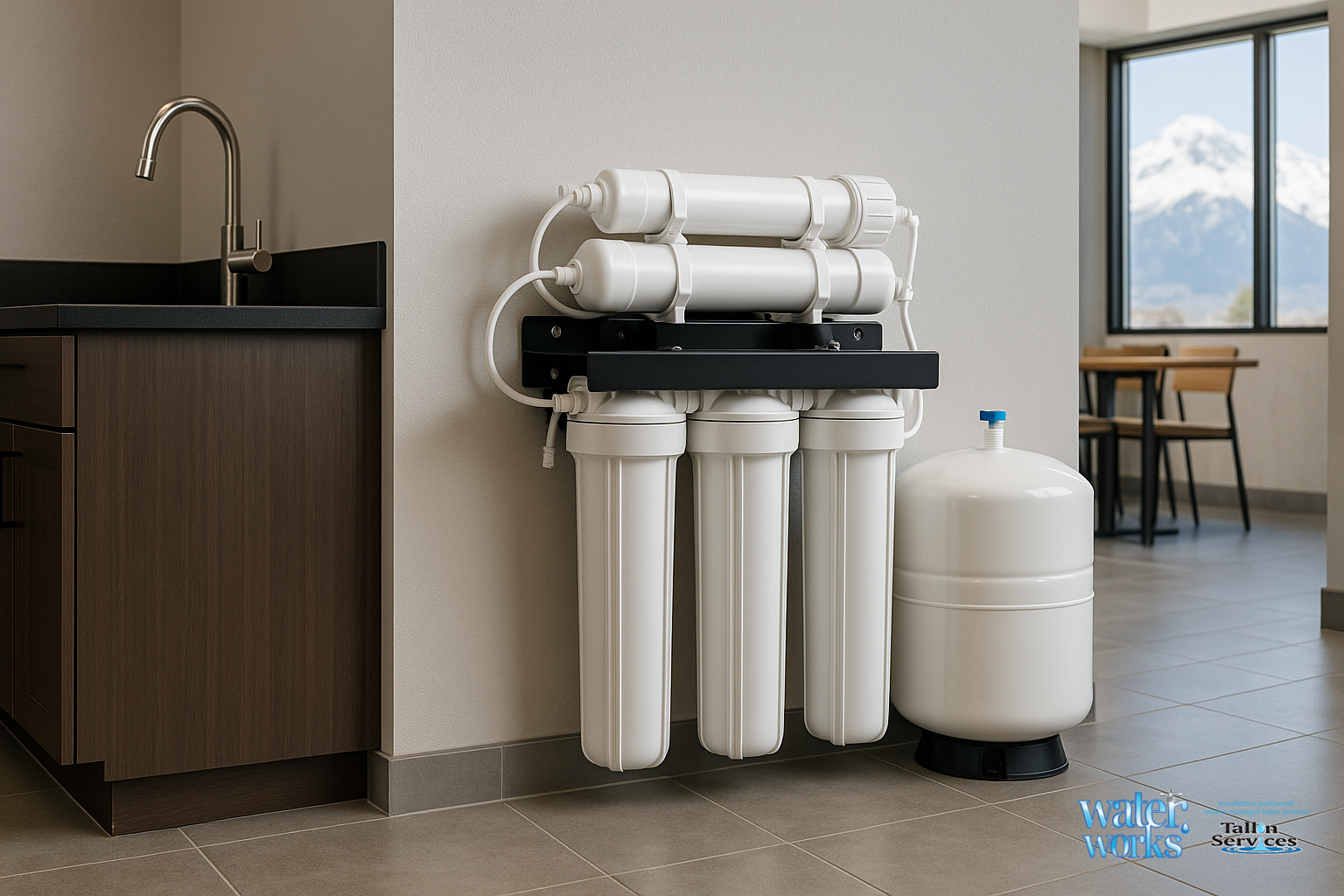
For most Boulder homes on the city supply, the right answer is a layered system sized to the actual water at the tap. A softener at the point of entry handles the working hardness and protects appliances, plus a reverse osmosis unit under the kitchen sink pulls the trace metals, disinfection byproducts, and any residual radium down to drinking-water levels at the one tap your family actually drinks from. A small carbon stage ahead of the RO polishes chlorine taste and odor and protects the RO membrane. Older homes with documented lead solder or brass-fixture concerns often pair the treatment with a point-of-use lead-certified filter at the kitchen tap until the plumbing can be replaced.
For foothills homes on private wells, the layered system is similar in shape but different in the details. Wells running low pH need a neutralizer ahead of the softener to protect copper plumbing the way the Summit County high country does, plus an oxidation filter or greensand stage for iron and manganese, and an anion-exchange or specialized media for arsenic where the rock delivers it. Shallow wells with coliform risk pair the rest of the system with a UV disinfection stage so bacteria do not make it to the tap, and a reverse osmosis unit at the kitchen tap covers the rest of the drinking-water concerns — nitrates, VOCs, anything carbon leaves behind.
We design the system, install it, and verify the treated water meets the mark at every tap it is used. Then we come back: Boulder water should be tested at least once a year, and we keep your system serviced and your water verified season after season — including a retest after the spring runoff, after changes in nearby land use, and after any work on the well, the pump, the plumbing, or the fixtures that could shift the profile. Coverage runs out of our Northern Colorado office across the I-25 corridor and the Front Range foothills, with statewide dispatch out of our four regional offices for anything outside the immediate area.
- Free on-site water analysis
- Water softeners sized to Boulder hardness and foothills well water
- Acid neutralizers for low-pH foothill wells where the rock runs acidic
- Iron, manganese, and arsenic filtration for foothill well water
- Reverse osmosis for drinking-water taps (city and well)
- Carbon filtration for chlorine taste and odor and disinfection byproducts
- UV disinfection for coliform risk on shallow foothill wells
- Annual testing and ongoing service
Coverage across the Boulder area
Service routes across the I-25 corridor and the Front Range foothills
Boulder's position on the map is what determines how service routes to it. The city sits at the western edge of the I-25 corridor between the foothills and the plains, close enough to the Northern Colorado office that the daily run out to a foothills well or a historic in-town neighborhood is a routine day, not a special trip. Our service techs leave the Northern Colorado office, run south on I-25, and arrive in Boulder as a normal scheduled stop. That matters more than people expect, because most of the foothills homeowners in the outer ring are on private wells that nobody but us is testing.
Coverage out of the Northern Colorado office runs the I-25 corridor north from Boulder through Boulder County and into the southern edge of Larimer County — Longmont to the northeast, Lafayette and Louisville to the east, Superior and Erie along the county line, and the foothills homes and small acreage properties scattered into the canyons west of town. On-site well testing, softener and reverse osmosis installs, and iron-and-manganese filtration work on older foothills properties with private wells are routine jobs for that crew. For homes further out along the foothills belt or up into the canyons where the snowpack sits longest, statewide dispatch out of our four regional offices covers the gap, and a service run into that country is a normal ask, not an exception.
What foothills installs require is a little different from in-town work. Older foothills homes run higher treatment demand than the city average — bigger service flow, more bathrooms and outbuildings on the same plumbing, longer runs between the wellhead and the house, and the occasional need for service-line freeze protection where the elevation climbs. Our techs size softeners, pre-filters, and reverse osmosis units to the actual well, the actual household, and the actual number of taps (human and landscape) on the system, not a generic spec. And because the contamination profile on foothills wells tends to shift with seasonal runoff and nearby land use, we keep every install on an annual testing cycle so we catch a trend before it shows up in your tap.
- Northern Colorado office — I-25 corridor from Boulder north through the Front Range foothills
- Statewide dispatch for anything outside the immediate I-25 corridor and foothills belt
- Scheduled routes to Longmont, Lafayette, Louisville, Superior, and Erie
- On-site well testing, softener installs, and RO work on older foothills homes with private wells
- Higher service flow and longer plumbing runs sized into every foothill install
- Annual testing programs across Boulder County
Boulder water treatment FAQs
Is Boulder's tap water safe to drink?
Boulder's tap water is supplied by the city's Public Works Utilities Department and comes from surface sources on both sides of the Continental Divide — the upper Colorado River watershed and Boulder Creek, fed by Barker Reservoir, Silver Lake Reservoir, and Boulder Reservoir and treated and disinfected before it reaches your tap. The city runs roughly 25,000 drinking-water tests a year against about 500 substances and publishes an annual water-quality report. ‘Municipal and tested’ and ‘good at your kitchen sink’ are not the same thing, though: average hardness sits around 42 mg/L (about 2.4 grains per gallon), chlorine residual is on by design, and older homes in the historic neighborhoods often still have copper service lines or lead solder that can pick up trace metals between the main and the faucet. The only way to know what is actually coming out of your tap is a real on-site test at your address.
What contaminants are most common in Boulder water?
On the municipal side, the contaminants the city tests for and reports on include haloacetic acids, trihalomethanes (disinfection byproducts of the chlorine residual), chromium, lead (typically from lead solder and brass fixtures in older homes rather than the source water itself), and the radioactive isotopes that show up in the granite bedrock of the upper Colorado watershed — naturally occurring radium is the one most homeowners ask about, and it is exactly why a per-address test matters. Inside the city, hard water and chlorine taste and odor top the everyday list; in the unincorporated foothills and the outer reaches of Boulder County where homes run on private wells, the list is more agricultural: coliform and E. coli after heavy runoff, nitrates from fertilizer and feedlot runoff upgradient of the wellhead, arsenic and manganese from the alluvial material, iron staining on fixtures, and occasional VOCs near older septic systems. A genuine on-site analysis covers municipal plumbing and well-water cases together.
How often should I test my water in Boulder?
For homes on the city supply, test at least once a year for the basics — hardness, chlorine residual, pH, total dissolved solids, lead and copper (especially if your home was built before 1986), and any radium you want confirmed against the city's published number. For homes on a private well, test annually for coliform bacteria, nitrates, and anything else the geology and surrounding land use suggest — plus an arsenic check, since the alluvial material along the foothills can carry it. Test again after any major storm or spring snowmelt pulse (runoff pushes surface water into shallow wells and can shift TDS at the tap), after any work on the well, pump, or plumbing, and after remodeling in a pre-1980 home where you've disturbed solder or pipe joints. Annual testing is the floor, not the ceiling; the foothills wells reward consistency.
Do Boulder homes really need a water softener?
Most do. The treated city water still averages around 42 mg/L hardness (about 2.4 grains per gallon) coming out of the plant, and inside many homes the working hardness climbs above that because of mineral pickup in older copper service lines and the long runs to the foothills neighborhoods. Hard water shows up the usual ways — spotting on glassware, scale on faucets, shower glass, and tile, shortened lifespans for water heaters, dishwashers, washing machines, and ice makers — and on the foothills properties pulling from private wells, the working hardness can run considerably higher than the city average. A properly sized ion-exchange softener removes the calcium and magnesium that drive the damage. Salt-free conditioners help with scale precipitation but do not actually pull the hardness minerals out, and on Boulder water the difference shows up fast on fixtures and appliances.
Can you service my home outside of Boulder?
Yes. Our Northern Colorado office at (970) 381-4493 covers Boulder and the surrounding communities along the I-25 corridor and the Front Range foothills — Longmont, Lafayette, Louisville, Superior, Erie, and the unincorporated Boulder County foothill homes east of the Rockies — and our service techs run scheduled routes across the area year-round. On-site well testing, softener and reverse osmosis installs, and filtration work on the older foothill properties with private wells are routine work for that crew. Statewide dispatch out of our four regional offices covers the rest of Northern Colorado and the Eastern Plains when a job calls for it, and our Northern Colorado office remains the day-to-day dispatcher for the I-25 corridor.
Get a free water analysis in Boulder
Find out what is actually in your water — city tap in town, foothills well outside city limits, or a historic in-fill home with older plumbing. We will test on-site, walk you through the results, and design a treatment system around your source, your household, and your preferences. Schedule with our Northern Colorado office at (970) 381-4493 for fast coverage across Boulder and the surrounding I-25 corridor and Front Range foothills communities, with statewide dispatch out of our four regional offices for anything further out.
Get a quote- Denver Metro(303) 248-3390
- Northern Colorado(970) 381-4493
- Colorado Springs Metro(719) 694-2650
- Pueblo & S Colorado(719) 836-8118
From the blog